The Business Card Under a Rock: What Actually Wins Renovation Jobs Now
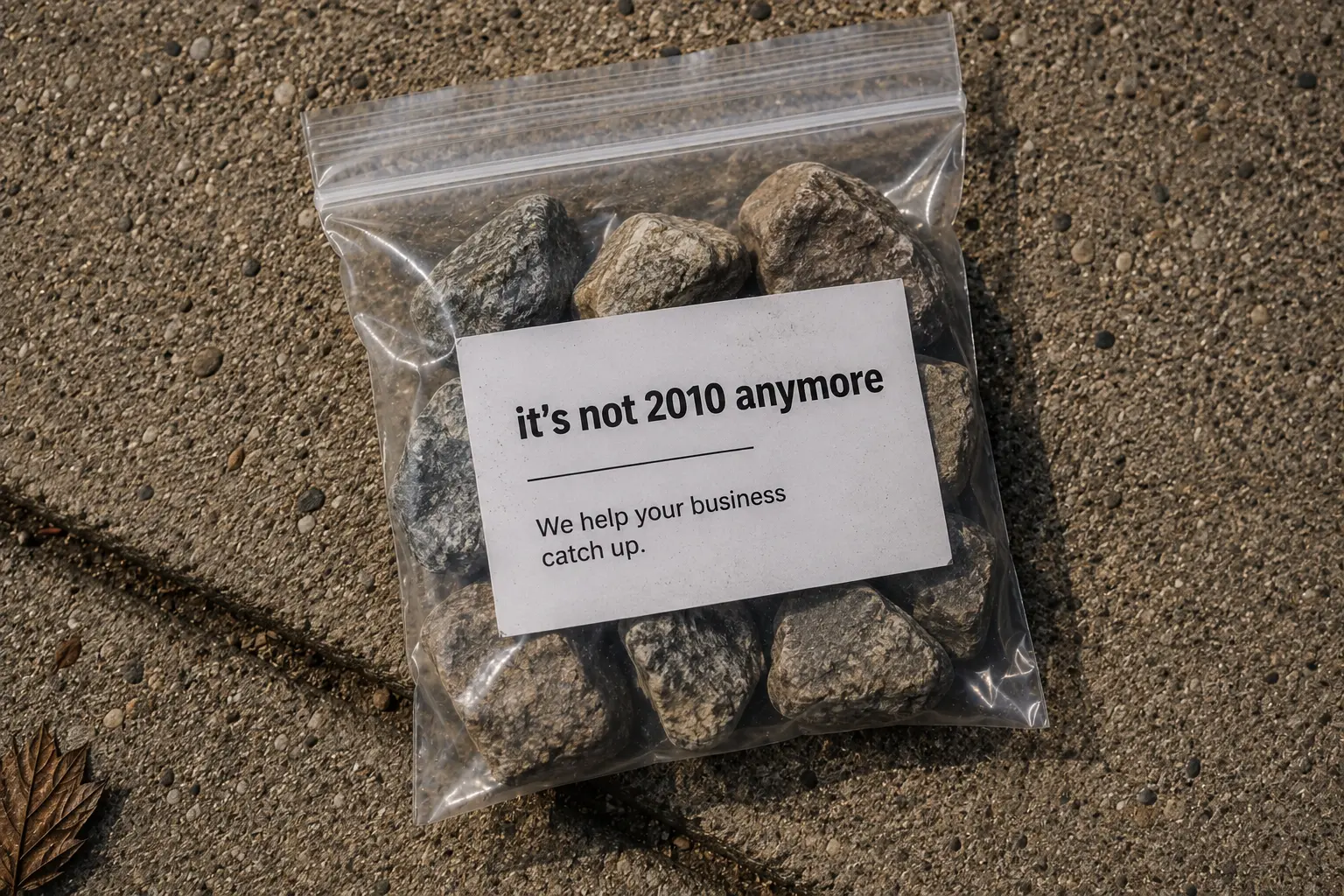
You know the move. Someone drives the neighborhood early in the morning, and by breakfast every driveway has a business card pinned under a small rock.
We want to say this first: we respect the hustle. That card represents a real person out there working for their next job, and that work ethic is exactly what makes a great contractor. This post is not about mocking old-school marketing. It is about what happens in the thirty seconds after a homeowner picks that card up.
Because that part has completely changed.
The industry got bigger, and the way people buy got different
Home improvement in the US is now a market of more than $600 billion a year, and it is running about 50 percent above pre-pandemic levels, according to Harvard's Joint Center for Housing Studies. More homeowners are renovating than ever. That is the good news.
The other news is that how they choose who to hire moved online, and it happened a while ago. Back in 2016, Pew Research found that 82 percent of US adults were already reading online reviews before first-time purchases. Today it is close to universal. BrightLocal's annual consumer survey puts it at 97 percent of consumers reading reviews for local businesses, and about half say they trust those reviews as much as a personal recommendation from someone they know.
Read that last part again. For half your future customers, your Google reviews ARE word of mouth now.
What actually happens to that business card
Best case, your card lands on the one driveway where the homeowner needs your exact trade that exact week. Here is what she does next.
She Googles you.
Not to be difficult. To do her homework, the same way you would. She wants to see photos of your work, what your last ten customers said, whether you are licensed, and whether you look like a real, active business.
So the card worked. It sent her to the internet. The question is what she finds when she gets there.
If she finds a complete profile with recent photos and recent reviews, that card just earned its keep. If she finds nothing, you paid to send a ready-to-buy homeowner straight to the search results where your competitors live. The card did its job. Your online presence didn't show up for its shift.
We watched this from the homeowner's side, 105 times
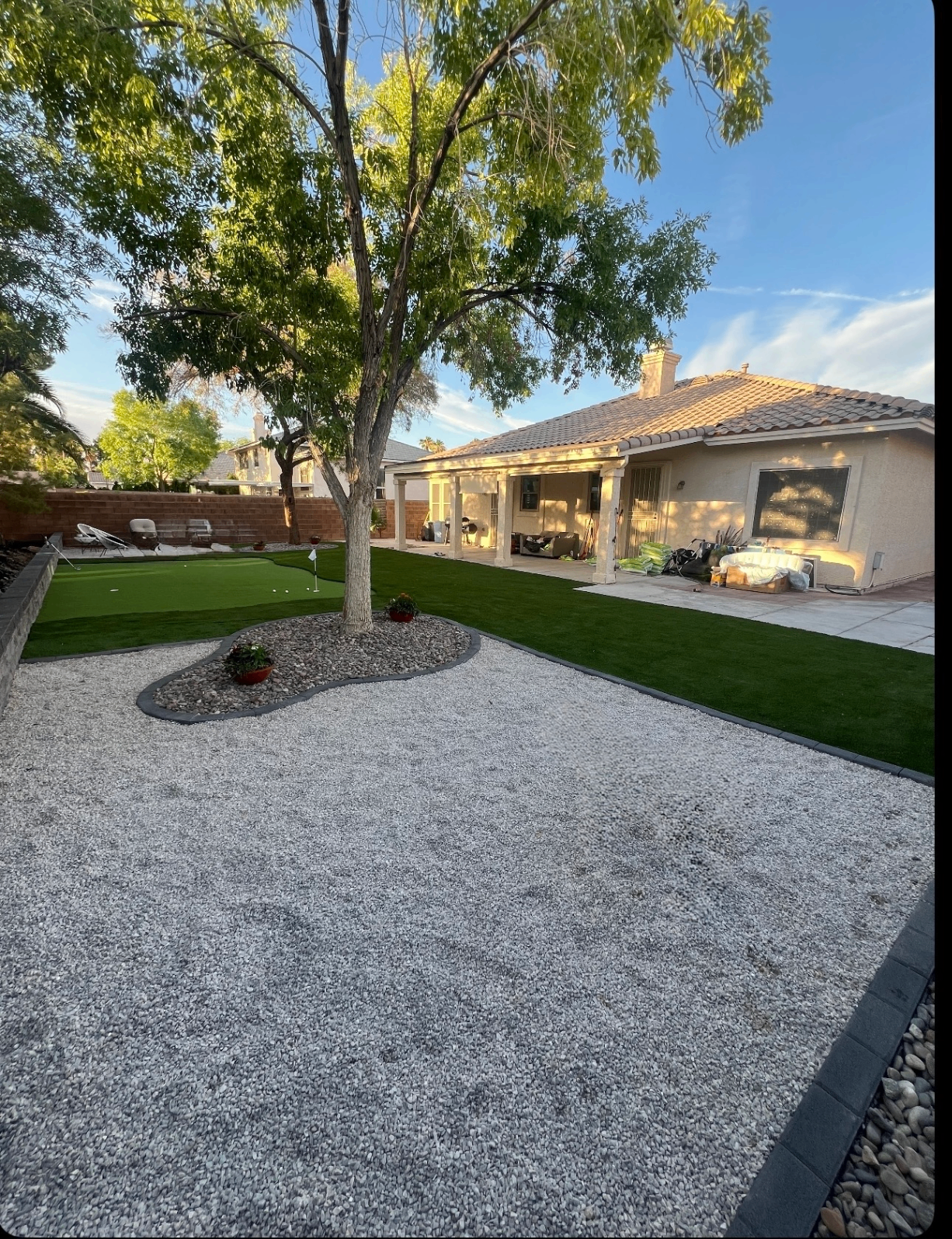
Before Myzer was a company, it was our own backyard. We contacted 105 landscaping companies in Las Vegas for one project. Only 50 ever got back to us with a quote. Thirty came out to see the yard. Just 25 of those sent a real final number.
That means more than half of the businesses we reached out to never responded to a homeowner with a funded project and every intention of hiring. The companies that won our shortlist were not always the cheapest or the biggest. They were the ones who were easy to find, easy to check out, and quick to respond.
That is the whole game. Being findable and being responsive is most of what "marketing" means in this industry now.
The foundation: three things, in order
1. A Google Business Profile (free)
If you do only one thing after reading this, do this one. It costs nothing.
Google's own data says customers are 2.7 times more likely to consider a business reputable when it has a complete Business Profile, 70 percent more likely to visit, and 50 percent more likely to consider purchasing. Complete means photos, hours, service area, and a real description, not just a name and a phone number.
Your reviews live here too, and freshness matters more than most pros realize. In BrightLocal's survey, 74 percent of consumers said they prioritize reviews written in the last three months, and a growing share will only consider businesses rated 4.5 stars or higher. A five-star review from 2022 is not doing the work you think it is. Asking every happy customer for a review, every time, is the highest-ROI habit in this whole post.
2. A website (your proof)
Your website is the job-site walkthrough that happens before you ever get the call. It holds the things a card cannot: photo galleries of finished work, the services you actually offer, your service area, your license number, and a way to reach you that works at 9pm on a Sunday, which is when homeowners actually sit down to research.
One more reason this matters more every month: people are starting to ask AI tools for local recommendations. BrightLocal found 45 percent of consumers now use tools like ChatGPT to help find local businesses, up from 6 percent a year earlier. Those tools learn about you from the open web. A business with no website and no profile is invisible to them. You cannot put a card under a rock on a chatbot.
3. Targeted ads (the amplifier, last)
Ads work, but only in that order. An ad is you paying to borrow attention, and it has to send people somewhere. If the somewhere is a complete profile and a solid website, ads can be a measurable machine: you know what a lead costs, which zip codes convert, and which jobs came from where. If the foundation is not there, ads are renting attention you have nowhere to keep.
The ROI question, answered honestly
We are not going to invent a response-rate statistic for driveway cards, because none exists. That is actually the point.
A card drop costs you a morning and a box of cards, reaches whoever happens to live on that street, lands at the right moment for almost none of them, and tells you nothing about what worked. It is a one-shot message that is in the trash by Tuesday.
A profile, a website, and a review habit compound. The review you earn in March is still winning you jobs in October. The photo gallery works every night while you sleep. And all of it is measurable: calls, direction requests, form fills, cost per lead. You cannot improve what you cannot measure, and with the rock-and-card method, you cannot measure anything.
Keep dropping cards if they are working for you. Just make sure that when the card works, the Google search that follows it works too.
The takeaway
Word of mouth still wins jobs in this industry. It always will. What changed is where word of mouth lives. It moved from the fence line to the search results, and 97 percent of your future customers are reading it there.
The foundation is one free profile, one honest website, and the habit of asking for reviews. Ads come after, if at all. None of it requires being a tech person. It requires the same thing that built your business in the first place: showing up where the customer is.
That is the part we do. Myzer builds websites and online presence for construction businesses, so the pros who are great at the work are just as easy to find as the ones who are merely great at marketing. To be clear, we are not a contractor and we do not perform any construction work. We work on the online side, for the people who do the building.
Want homeowners to find you the way they are actually looking? Come see what we do at myzer.co.
Your next customer is already searching.
Myzer builds the website and online presence your work deserves, so homeowners find you the way they actually look.
Book a free demo