Can AI Recommend Your Business? Go Ask It Right Now
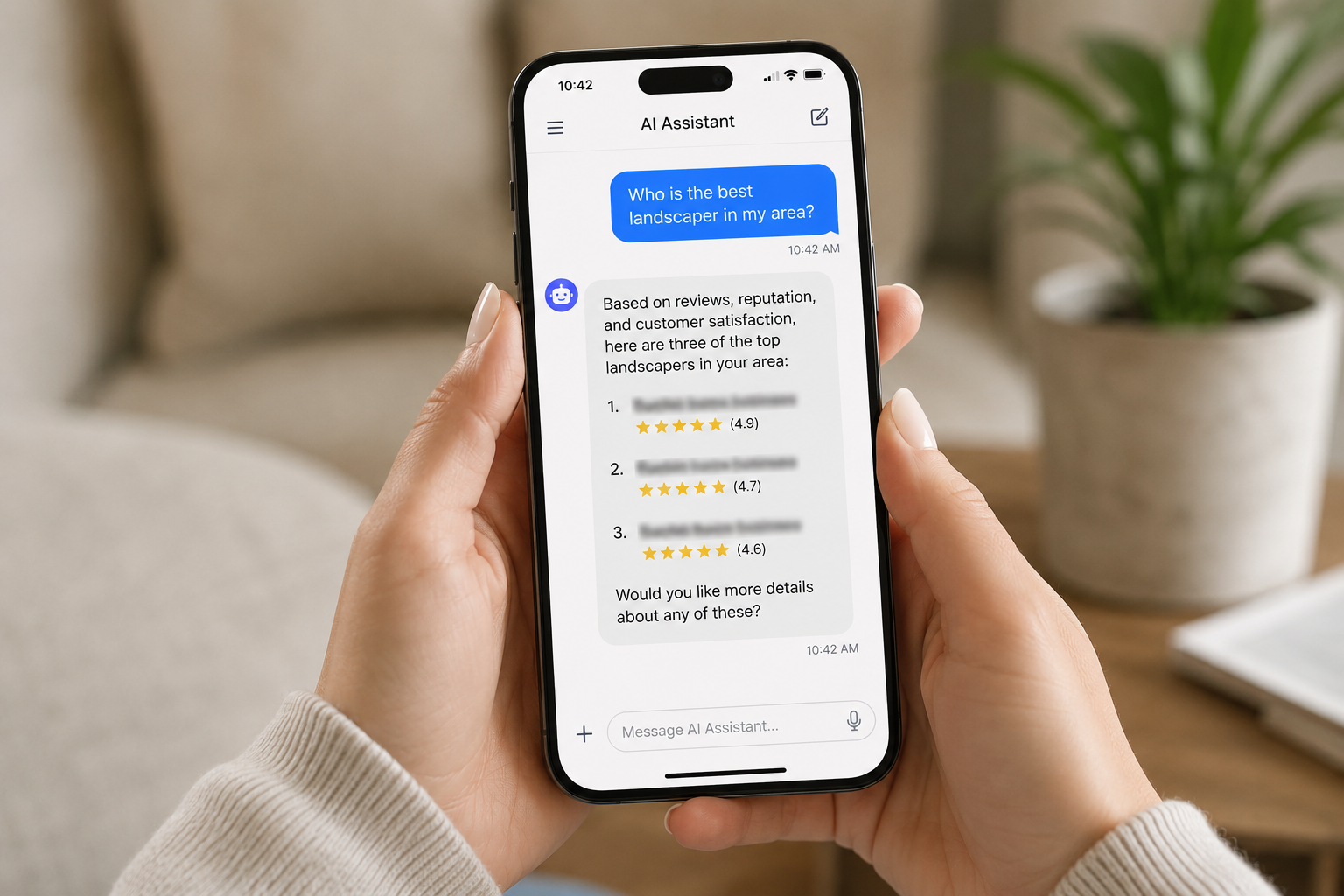
Before you read another word, try something. Open ChatGPT, or Google's AI Mode, and type: "Who is a good [your trade] in my area?"
Did your business come up?
If it did, congratulations. You just got a referral from the fastest-growing source of customer recommendations in the country, and it cost you nothing. If it didn't, keep reading, because this post is about why, and what you can do about it.
This went from fringe to mainstream in one year
A year ago, asking a chatbot to recommend a local business was a novelty. Not anymore.
BrightLocal's 2026 consumer survey found that 45 percent of consumers now use AI tools to find local businesses. One year earlier, that number was 6 percent. That is not a trend line. That is a cliff, in the good direction, for the businesses that are ready for it.
AI is now the third most-used way people find local recommendations, behind only Google and Facebook. It has already passed Yelp.
And look at who is doing the asking. Among 30 to 44 year olds, 64 percent have asked AI for a local business recommendation. That age range is prime first-home, first-renovation territory. The homeowner most likely to ask a chatbot who to hire is the same homeowner planning a kitchen remodel.
Do they trust the answer? Increasingly, yes. Among people who use AI tools, 63 percent trust the recommendations they get, and 42 percent of all consumers say they trust AI recommendations as much as traditional reviews.
How does AI decide who to recommend?
Here is the part that matters for you. An AI tool has never seen your work. It cannot shake your hand, look at your truck, or hear your neighbor rave about the patio you built.
Everything an AI tool knows about your business, it learned from the open web. Your website. Your Google Business Profile. Your reviews. Local directories. Articles and pages that mention you. It reads all of that, and when a homeowner asks for a recommendation, it answers from what it found.
Which means the math is simple. A business with a complete website, an active profile, and a steady stream of reviews gives AI plenty of material to recommend from. A business with none of that gives it nothing. The AI is not being unfair. It just cannot recommend what it cannot see.
SOCi's 2026 Local Visibility Index, which analyzed how AI platforms surface local businesses, found that these tools lean on plain, structured information: clear service descriptions, real addresses and service areas, FAQ-style answers, and consistent business details across the web. In other words, AI rewards the businesses that state the basics clearly, everywhere.
We said it in our last post and it is even more true here: you cannot put a business card under a rock on a chatbot.
The reassuring part: this is not a whole new job
Here is the thing that should lower your blood pressure. Getting recommended by AI is not some new discipline you have to learn on top of everything else. It is the same foundation we have been talking about all along, doing double duty.
BrightLocal found that 88 percent of people who get an AI recommendation still double-check it, mostly by looking at the business and its reviews. So the AI answer is a doorway, not the destination. The homeowner asks ChatGPT, gets three names, then Googles all three. Your profile, your photos, and your recent reviews still close the deal, exactly like they did before.
That means every hour you put into the fundamentals now pays you twice. Once in regular search, and once in every AI answer built on top of it.
Five things to do this week
- Run the test. Ask ChatGPT and Google's AI Mode for your trade in your city, a few different ways. "Best pool builder in my area." "Who should I call to redo a backyard near me?" Note what comes up. That is your starting line.
- Complete your Google Business Profile. Every field. Photos, hours, services, service area, description. It is free, and it is one of the first places both search engines and AI tools look.
- Say what you do, in plain words, on your website. Not just "quality craftsmanship since 2011." List your actual services and your actual service area in normal sentences a machine can read. "We install pavers, turf, and outdoor kitchens in [your city] and the surrounding areas" is worth more than a page of slogans.
- Add an FAQ. Answer the questions homeowners actually ask: what you charge for estimates, how far out you book, whether you are licensed and insured. AI tools love question-and-answer text because that is the exact shape of what users ask them.
- Keep the reviews coming. Fresh reviews feed both the AI's answer and the double-check that follows it. Ask every happy customer, every time.
The takeaway
Nearly half of consumers now ask AI tools who to hire, up from 6 percent a year ago, and the homeowners most likely to ask are the ones most likely to be planning a renovation. AI builds its answers from your website, your profile, and your reviews. If those do not exist, you are not in the answer.
The fix is not complicated and it is not new. It is the same honest foundation, working a second shift.
That is the part we do. Myzer builds websites and online presence for construction businesses, so when a homeowner asks the internet who to hire, in a search bar or a chat box, you are part of the answer. To be clear, we are not a contractor and we do not perform any construction work. We work on the online side, for the people who do the building.
Curious what AI says about your business right now? Run the test, then come see what we do.
Be part of the answer.
Myzer builds the website and online presence that search engines and AI tools read, so when a homeowner asks who to hire, your name comes up.
Book a free demo